

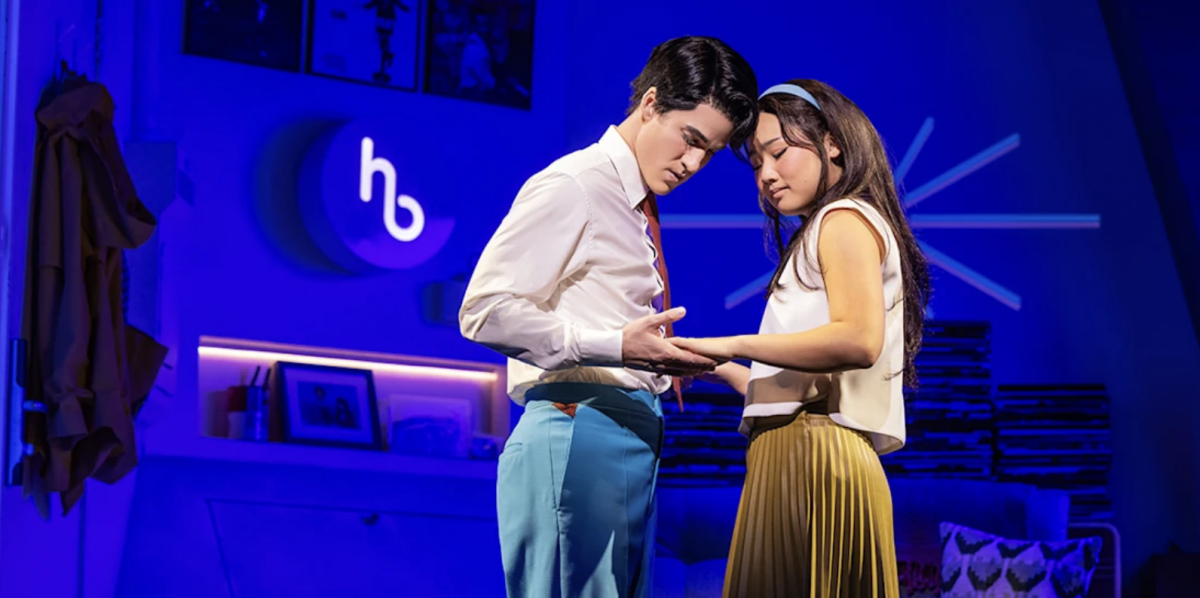
On Jan. 13, 2026, the hit Broadway musical “Maybe Happy Ending” announced the final performances of their two principal leads, Darren Criss and Helen J. Shen. It was later announced on the same day that Shen would be replaced by two of her standbys, Hannah Kevitt and Claire Kwon. “Maybe Happy Ending” opened on Nov. 12, 2024 at the Belasco Theatre in New York City to unanimously positive reviews. The show, directed by Michael Arden, was nominated for ten Tony Awards and won six for Best Musical, Book, Score, Actor, Direction and Scenic Design.
Set in a near-future Seoul, “Maybe Happy Ending” tells the story of Oliver and Claire, two human-like “Helperbots” who form a deep connection with one another and explore love, purpose and life as they embark on an unexpected adventure to Jeju Island. It features lyrics written by Hue Park, music composed by Will Aronson and script written by both Aronson and Park. The original Broadway cast included Darren Criss as Oliver, Helen J Shen as Claire, Marcus Choi as Oliver’s owner James and Dez Duron as jazz singer Gil Brentley.
Criss previously left the cast on Aug. 31, 2025 and returned on Nov. 5, 2025. During this period of time, he was replaced by Shen’s offstage boyfriend, Andrew Barth Feldman. This sparked some controversy among Asian theatre fans and artists, with many saying that casting Feldman, a white and Jewish actor, in a show set in Korea with an almost all-AAPI cast and crew, added to the issue of Asian-Americans being underrepresented in American theatre. Others claimed that since Oliver and Claire are robots, the race of the actor did not matter.
As an Asian-American theatre fan myself, I am well aware of the underrepresentation of AAPI actors on Broadway. When the original cast for the show was announced, many fans, including myself, were thrilled to see a largely Asian cast and crew. Audiences saw “Maybe Happy Ending” as a chance for AAPI actors to shine. While robots can be race-independent roles, I believe that casting a non-Asian actor as the male lead is not the best choice for this show. This is especially since the show publicly prided itself on being authentically “Asian” in its promotional marketing, specifically surrounding the Tony Awards when Criss, who is half-Filipino, became the first Asian-American actor to win the award for Best Actor.
When “Maybe Happy Ending” announced the casting of Feldman, one Instagram user commented, “I’m so extremely disappointed in this decision, especially when it felt like we were taking small steps towards something that feels like representation and authenticity for AAPI artists in this industry.” Another user said, “to cast a white man as a Korean character despite the fact that there are MANY [Asian] actors on Broadway that would definitely play the part is very strange and disappointing to me.”
As much as I love this show, I agree with these comments. When I saw “Maybe Happy Ending” last summer, I was inspired by seeing so many talented actors who looked like me on stage. I love watching shows on Broadway, and I often see little to no Asian actors in the casts of the shows that I watch. In a show that was seen as a rare opportunity for AAPI representation on Broadway, I believe that Asian actors should play the lead roles, especially since the show is set in Korea as well. The simplest route that the producers could go on is to cast the two standbys for Oliver, Stephen Huynh and Christopher James Tamayo.
That being said, I still believe that Feldman is a terrific actor, having played the lead role in other hit musicals such as Dear Evan Hansen and Little Shop of Horrors. However, after all the controversy surrounding his casting, I believe the best course of action for “Maybe Happy Ending” would be to cast AAPI actors as the new leads to provide authentic representation and continue to serve as a beacon of light for other AAPI performers and fans across the globe.