

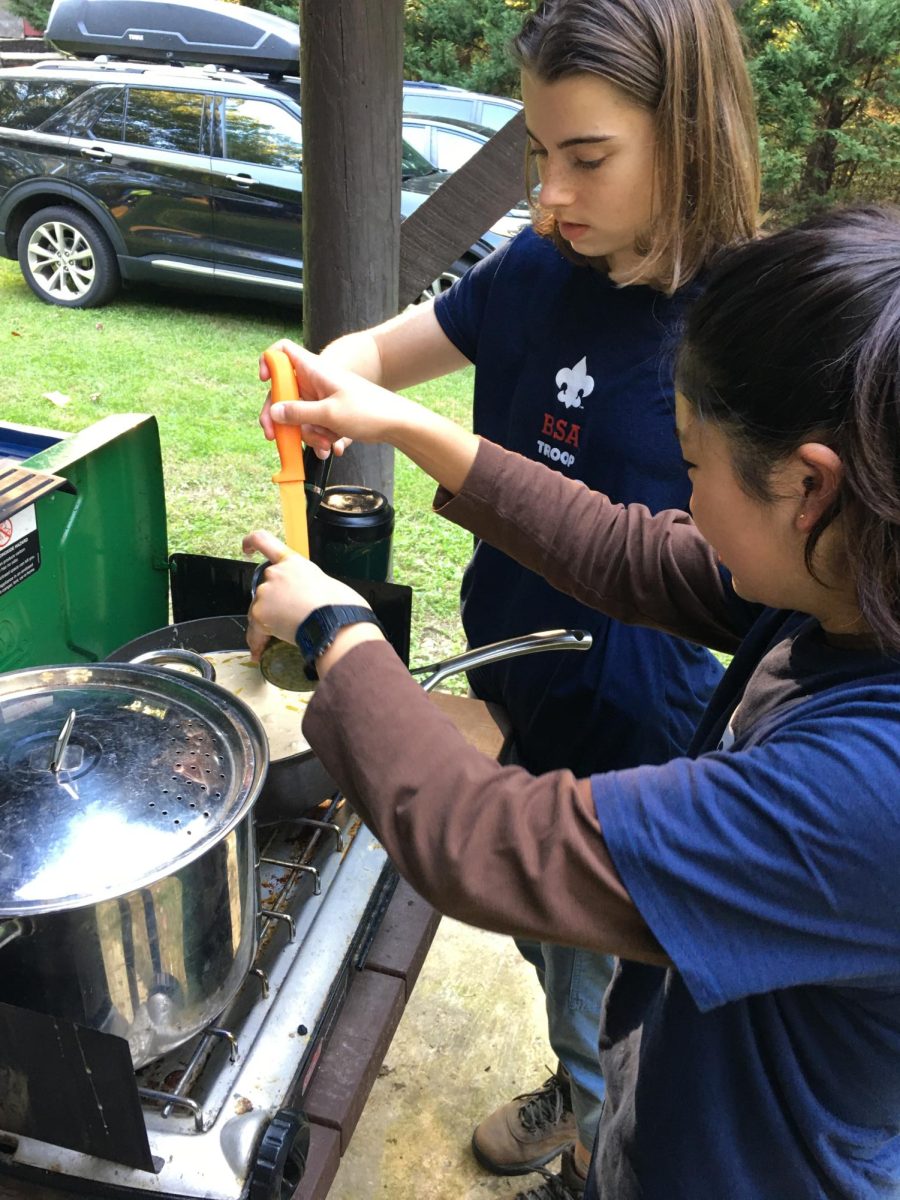
Tasks for students can include working on a group project or reviewing lecture slides and notes, but for an Eagle Scout, a lot more is on their plate. They learn to navigate the countless homework assignments and scout projects so they can thrive in both environments.
Boy Scouts of America (BSA) is an organization that has been around for over 115 years. BSA provides leadership opportunities for young men and young women in grades 6-12. The Scouts’ leaders push the team through real-life problem-solving scenarios and hands-on projects that solve a problem in their community.
“I wanted to do something more hands-on and service [and] community focused,” junior Eagle Scout Jack Gao said. “At [Jefferson], you do a lot of STEM [focused work], so it was nice to see a new [perspective] on what you can do.”
First created in 1912, being an Eagle Scout is the highest rank in BSA.
“My brothers were eagle scouts before I could join,” Eagle Scout Juliet Phillips said. “Girls were able to join the scouts BSA program in 2019, [so] I joined because of my brothers.”
Eagle Scouts take on leadership positions, volunteer in their community and show higher levels of planning and preparation skills. They show these skills in their service projects.
“[For my project], I built a fire pit for my American Legion post,” senior Eagle Scout Daniel Draper said. “I built a stone fire pit with chairs and benches around it so that Patriots of the American Legion could go in cold weather [to] sit and talk outside of the building. We did it in two days.”
With the challenging classes at Jefferson, the rigorous coursework requires problem solving abilities and critical thinking—the same skills that are used as an Eagle Scout. One skill the Scouts have to learn is how to manage their spare time to balance both commitments.
“[You have to] find when you work well,” Gao said. “If you find yourself really tired in the afternoon, try working in the morning. [But] if you’re dead in the morning, don’t wake up early when you work well at night. I had to be really conscious of how I was using my time. Before junior year, I was able to get most of [my homework] in school. But now, I’ve taken more time in the mornings.”
They have to prioritize time management and make an effort in organizing their tasks to complete schoolwork on time.
“It’s really important for me to make sure that I [use] time blocks, especially with sports and going to service events,” Phillips said.
Being a part of two time consuming activities can also cause exhaustion, which is a challenge the Scouts have to learn to overcome.
“The hardest thing is motivating myself to go [to the meetings],” Phillips said. “[What motivates me] is [trying] to be positive for the younger Scouts. A lot of them are unsure how to progress in their scouting journey. It’s definitely important for me to go [meet with my troop], even after a long day a [Jefferson]”
Though they had to learn a sense of balance, there are also some advantages of being an Eagle Scout that further help them with their studies at Jefferson. The same skills learned as an Eagle Scout are also applicable to school.
“Scouts in general helped me gain leadership experience,” Phillips said. “[It] helped me learn how to work with different people. It really helped me at Jefferson to be good [at] projects and [doing] a lot of problem solving. Organization and planning is something that scouts do, so I have this skill to use at [Jefferson].”
Whether they are prepping for their next test or meeting with their troops, Eagle Scouts at Jefferson have to learn the ropes of managing their duties of being both a Scout and student.
“I thought [BSA] would look good on a college resume,” Draper said. “And you get to learn about nature and camping which is always helpful to know.”