

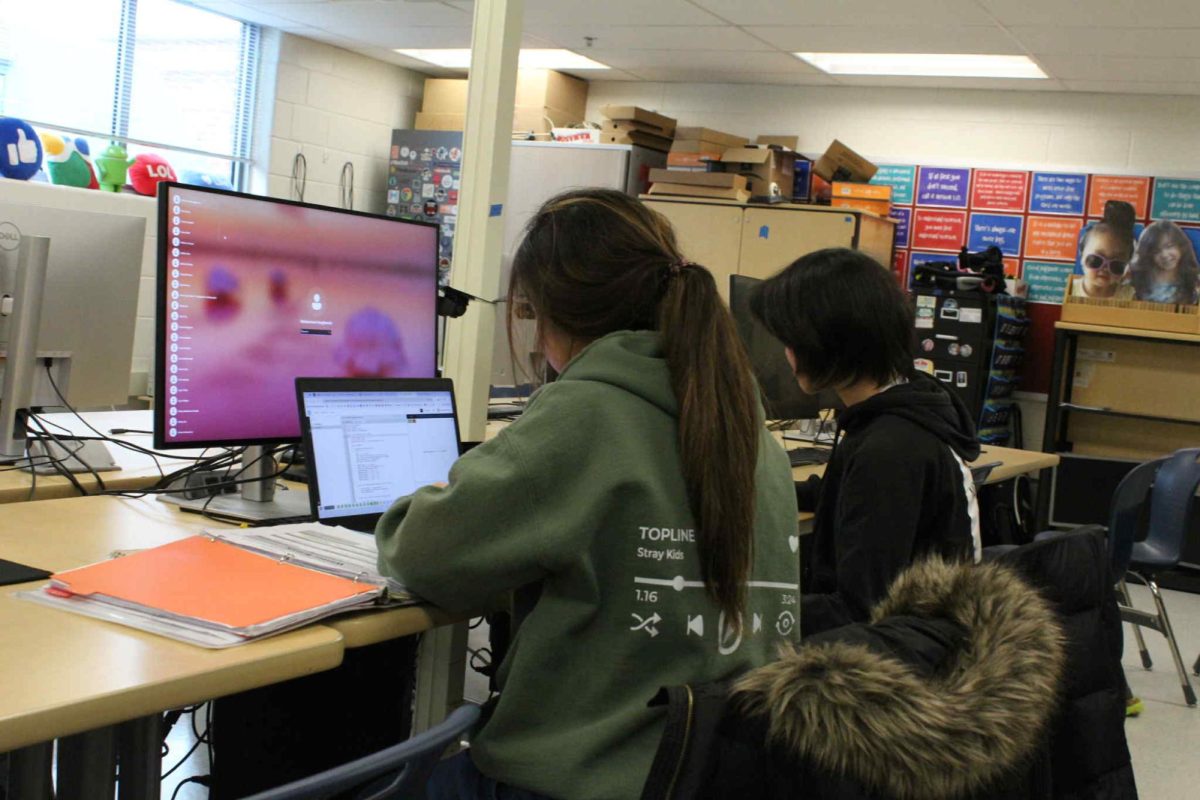
At Jefferson, classes such as Design and Technology and a computer science course are required for graduation. While these subjects are undeniably valuable, I think that requiring every student to take them is unnecessary and limits students’ academic freedom.
Design and Technology is a class a part of the freshman integrated Biology, English and Technology (IBET) program. The class teaches concepts including the engineering design process, data collection and analysis, robotics, sketching and prototyping. Design and Technology and computer science requirements are unique to Jefferson—they are not mandated by Fairfax County Public Schools (FCPS) or Va. Students at Jefferson would still meet all official FCPS graduation requirements to receive an advancement diploma without taking Design and Technology or a computer science class. When you graduate from Jefferson, you get a separate diploma. The extra requirements for the Jefferson diploma are to get a credit of computer science, consecutively complete three years of the same world language, complete one year of either Calculus AB or Calculus BC, take a math and science course all four years and earn a fourth social studies credit. While some of these requirements can be easily achieved, sometimes without realization, the extra classes like computer science can add pressure to Jefferson’s already demanding schedule. Graduation requirements should focus on core subjects that benefit all students, rather than specialized courses that may not align with everyone’s interests or goals.
Additionally, Jefferson should add a social studies class to the IBET curriculum, making it an option for students who are not interested in taking Design and Technology. Currently, students need to earn their fourth social studies credit through an elective spot—either in freshman year or later on—using up an elective slot that could have been dedicated to a class they are genuinely interested in. By offering freshmen the option to take a social studies course instead of Design and Technology, students can fulfill graduation requirements more efficiently, while also letting them have more flexibility with electives. By adding to the program instead of just replacing Design and Technology, this lets students have more academic freedom, because freshmen who are interested in both classes would then have the option to pursue both subjects.
Despite this, I don’t think that these classes lack importance, especially at a science, technology, engineering and math (STEM) focused school. However, these classes are relevant only to specific career paths like engineering, programming or graphic design. Making every student take them assumes that everyone shares the same interest—which isn’t true. I think Design and Technology would be better suited as an elective class, allowing students who are passionate about the more specific subject to engage deeply while others can still pursue their own interests. The same reasoning applies with computer science. While computer science classes are already electives, it is still required to have one credit of it to graduate, which also contradicts the idea of an elective in the first place.
Someone can still reason that having these classes as requirements ensures that all students develop the same essential 21st century skills that Jefferson values. Especially in a rapidly advancing digital world and with the new use of artificial intelligence (AI), exposure to coding, technology and design can be seen as beneficial regardless of future plans. It could also mess up the IBET curriculum if Design and Technology is removed, as it has been part of Jefferson’s freshman curriculum for a long time. However, requiring these courses is not the most effective way to achieve that goal. Students at Jefferson already develop these skills through other classwork like digital research, presentations and collaborative projects. Plus, the elements of a social studies class can easily be incorporated into IBET, as done so in the sophomore and junior humanities (HUM) classes. Having all students take these courses doesn’t always guarantee meaningful learning. A STEM school should inspire curiosity, not impose strict academic paths.
Jefferson should be prioritizing choice and flexibility. Removing Design and Technology and Foundations of Computer Science as mandatory courses, but still offering them as electives would maintain academic rigor for students who are interested, while still respecting individuality.